Parliamentarians Approved Model Law on Electronic Signatures
15 October 2026
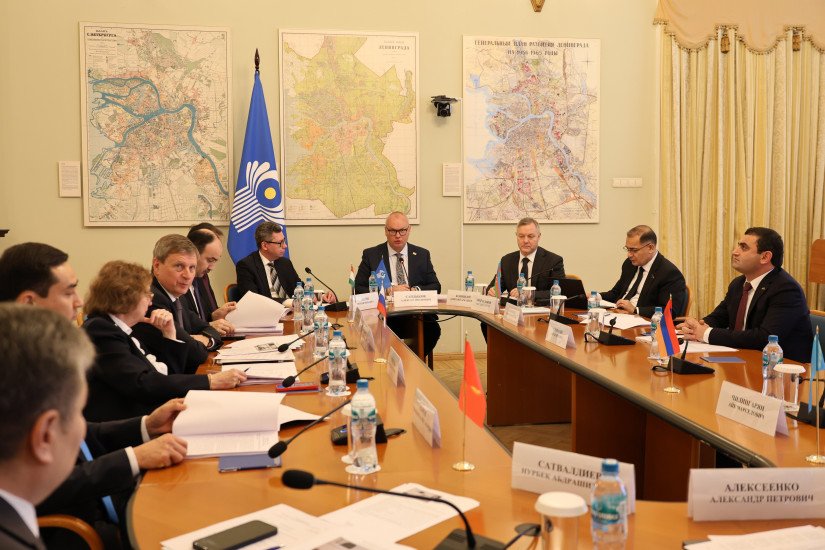
A meeting of the IPA CIS Permanent Commission on Economy and Finance was held at the Tavricheskiy Palace. The meeting was opened by Secretary General of the IPA CIS Council Dmitriy Kobitskiy.
A member of the Standing Committee of the National Assembly of the Republic of Armenia on Regional and Eurasian Integration Aleksey Sandikov was elected Chair of the Commission. Deputy Chair of the Committee of the Jogorku Kenesh of the Kyrgyz Republic on International Affairs, Defence, Security and Migration Zhyldyz Sadyrbaeva was elected Deputy Chair.
The participants reviewed the implementation of the 2023–2025 Forward Plan for Model Lawmaking in the Commonwealth of Independent States and discussed priorities for 2026–2028.
Associate Professor at the Department of Commercial Law of the Faculty of Law of St. Petersburg State University Aleksandr Alekseenko presented the draft of the revised Model Law on Electronic Signatures.
It was noted that the document aims to improve the legal framework governing the use of electronic signatures, including cloud-based electronic signatures, cross-border electronic interaction and the institution of a trusted third party.
The Commission decided to request that the IPA CIS Council submit the approved document for consideration at the Assembly’s next plenary session.
Deputy Head of the Department of Legal Regulation of Business at the Faculty of Law of the National Research University Higher School of Economics Elena Mokhova reported on progress in drafting the Model Law on Cross-Border Insolvency.
The document aims to ensure effective, fair and predictable regulation of cross-border insolvency, preserve the value of the debtor’s assets and safeguard the interests of all parties involved in the proceedings.
Senior Research Fellow at the Centre for Tax Policy of the Financial Research Institute of the Ministry of Finance of the Russian Federation Julia Steshenko informed the participants that work had begun on drafting Chapter 13, “Tourist Tax (Fee)”, of the Special Part of the CIS Model Tax Code. She also presented the concept for the future document.
Head of the Department for Scientific and Methodological Foundations of Metrological Services in the Field of State Regulation at Rostest (the Federal Budgetary Institution “State Research Centre for Testing and Metrology”) Bakhtiyar Pashayev spoke about work on the draft of the revised Model Law on System of Single Measurements. The draft aims to update requirements for measurements, measurement-unit standards, reference materials and measuring instruments, as well as to harmonise the legislation of CIS Member Nations in this area.
Deputy Head of the IPA CIS working group responsible for drafting the Model Law on Stimulating Tradable Infrastructure Debt Instruments, a partner at VERBA LEGAL and Head of the Infrastructure and Public-Private Partnership Practice Alexander Dolgov reported on the group’s work. He presented a thoroughly developed concept for the proposed legal act.
Chair of the Committee of the Legislative Chamber of the Oliy Majlis of the Republic of Uzbekistan on Budget and Economic Affairs Sharofiddin Nazarov informed the participants about the use in Uzbekistan’s national legislation of model legislative acts and recommendations developed by the IPA CIS Permanent Commission on Economy and Finance.
He noted that, amid large-scale reforms, CIS model lawmaking was regarded not merely as a theoretical reference point but as a strategic instrument for implementing international standards. According to him, under the 2023–2025 Long-Term Plan, provisions from 17 adopted documents had been put into practice through legislation in Uzbekistan.
He added that model laws on the digital space, digital financial assets and digital rights had laid the foundation for regulating financial technology, crypto-assets and e-commerce. Updates to the CIS Model Tax Code had helped simplify the taxation of self-employed persons. The Parliament of Uzbekistan intends to continue its active participation in the Commission’s work.
Secretary of the Commission Roman Levin reported on the incorporation of model legislative acts and recommendations developed by the Commission into the national legislation of CIS Member Nations. The largest number of instances of implementation concerned model acts on taxation, digital development, licensing and standardisation.
Alexey Sandikov outlined the Commission’s implementation of the 2023–2025 Long-Term Plan for Model Lawmaking in the Commonwealth of Independent States. A total of 17 documents had been adopted.
The 2026–2028 Long-Term Plan for Model Lawmaking in the CIS provides for the development of 26 legal instruments in the fields of economy and finance.